Click to enter complete search
Why space has become the new skills infrastructure in the workplace
Ben Somner
16th July 2026

Workplace design in recent years has been shaped by the desire to entice people back into the office. The response has been better amenities, more choice of how to work and richer social spaces. However, these are no longer enough and a more consequential shift is underway.

In a world where roles and tools are evolving exponentially, learning is becoming core infrastructure that enables skills to be developed and continuously renewed.

The World Economic Forum estimates that job disruption will equate to 22% of jobs by 2030, with 170 million new roles created and 92 million displaced. Just as importantly, employers expect 39% of key skills required in the labour market to change by 2030. In that context, workplaces that treat learning as an occasional event will struggle to stay competitive.

Increasingly, the most future-ready environments fuse work and learning through the creation of ecosystems that are embedded in the everyday rhythm of the organisation.

Learning as infrastructure

If learning is infrastructure, it needs to be designed with the same seriousness as any other operational system. It must be accessible, adaptable and able to serve different users at different moments, often simultaneously.

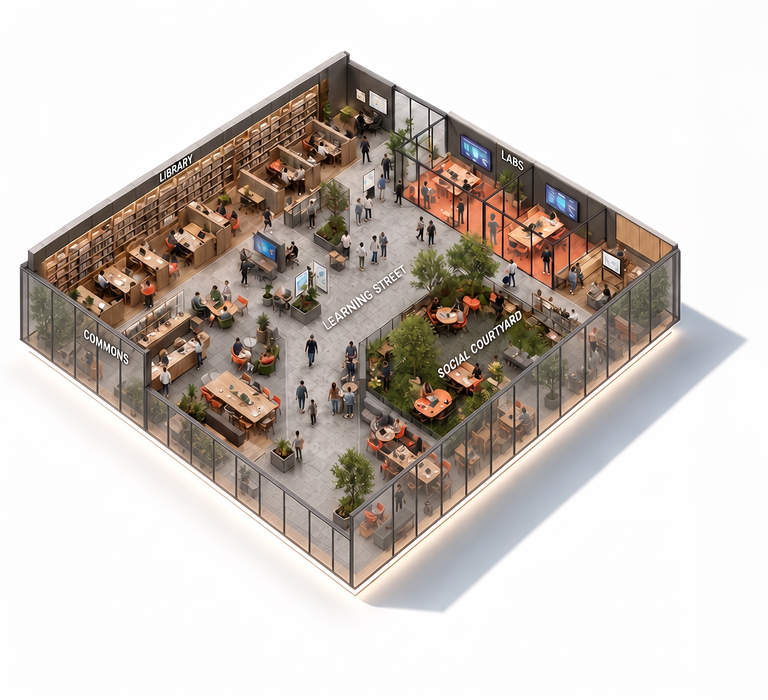
The modern learning environment is distributed through a network of settings that supports everything from deep concentration to mentoring, from structured teaching to spontaneous knowledge exchange. Increasingly, the critical spaces are not the formal classrooms but the third places: the in-between environments where learning becomes self-directed, unscheduled and often more memorable.

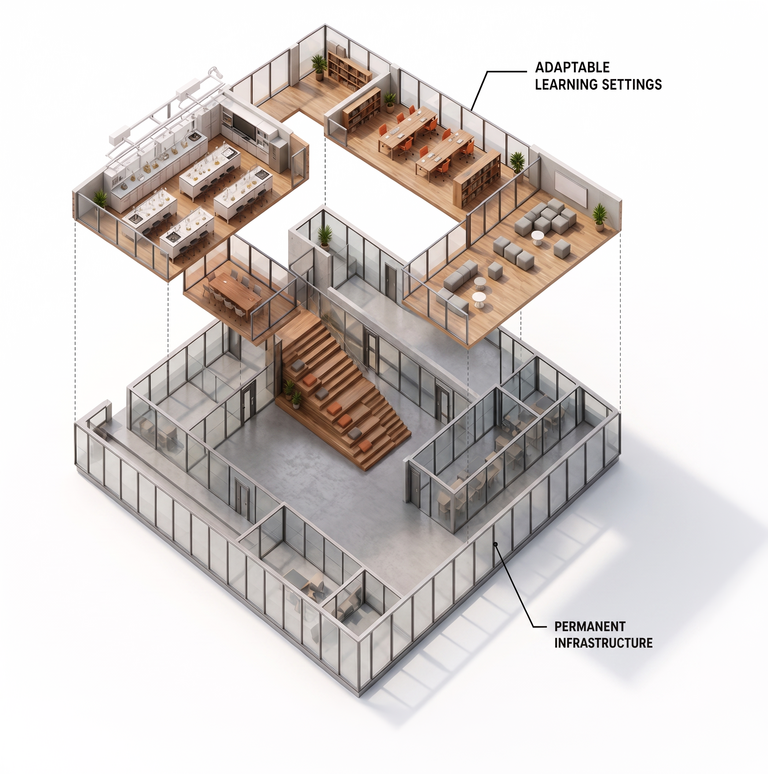
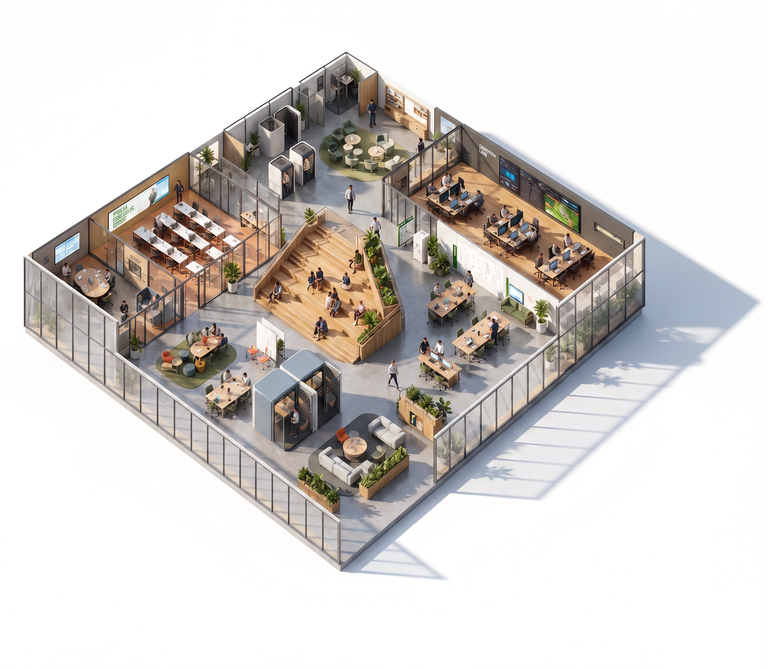
In practice, learning infrastructure looks like spatial layering with neighbourhoods and hubs, quiet libraries and project rooms, writable walls and digital labs, social staircases and town hall spaces, touchdown zones where a five-minute peer exchange is as valuable as a formal session.

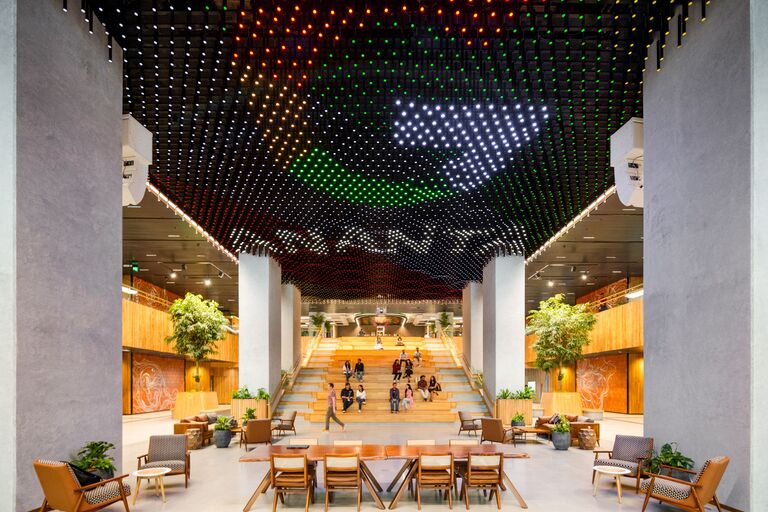
Architecturally, this means designing workplaces less as collections of fixed departments and more as campuses in miniature. Circulation becomes more than movement but places of exchange where atriums, stairs and shared thresholds become opportunities for visibility and connection.

From courses to continuous learning

How people learn is also changing as we move from fixed models to modular and ongoing skill development. In many sectors, capability now matters as much as formal qualification with teams built around problem-solving capacity.

A modular learning culture needs a modular spatial response as not learning comes in many forms and spaces must flex to support learners with different timetables, motivations and lived experience.

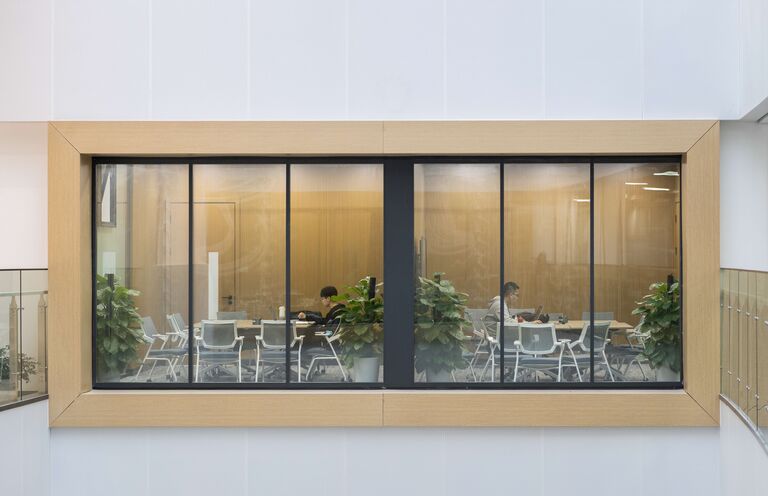
This is where the concept of learning ecosystems becomes so useful. At the University of Nottingham Ningbo China, the Li Dak Sum Incubator exemplifies a broadened vision of learning that is directly relevant to the workplace: a hybrid environment for learning, working and knowledge-sharing, supporting student entrepreneurs, academic researchers and external professionals.

That blurring of education and enterprise is no longer confined to campuses with many organisations now requiring similar hybrid spaces that can host onboarding one day, product testing the next, a leadership session the following morning and informal peer learning throughout the week.

This also creates an interesting tension between permanence and adaptability. Some learning infrastructure needs to be robust and long-term such as the social stairs, the atrium and the high-quality shared space but around that, other elements need to be much more flexible such as mobile furniture, reconfigurable project rooms, writable surfaces, operable partitions and technology that can support different formats of learning without constant reinvention.

AI will mean place matters more, not less

AI is the third accelerating driver of design and as tools become more intelligent, learning becomes more frequent and more personalised, but also more fragmented. People can access information instantly, but that information then has to be competently translated, absorbed and integrated.

This is the paradox we see repeatedly: as education becomes more digitally delivered and dispersed, the physical learning space becomes more, not less, important. It provides presence and shared context, crucial ingredients for collaboration and the kind of tacit learning that happens by watching how others work.

Design must respond by shifting focus from content delivery to practice environments. The most valuable learning spaces in an AI-enabled workplace are often those that support rehearsal, simulation, prototyping and demonstration. They are spaces where people are consuming knowledge and then able to test it, apply it and build confidence through shared experience.

Our work for Medtronic illustrates this clearly with a training centre designed to integrate high-fidelity simulation with social and collaborative space, supporting thousands of professionals annually. The building’s central atrium acts as a spatial connector, encouraging interaction and exchange, while adaptable teaching environments support evolving technologies and methods.

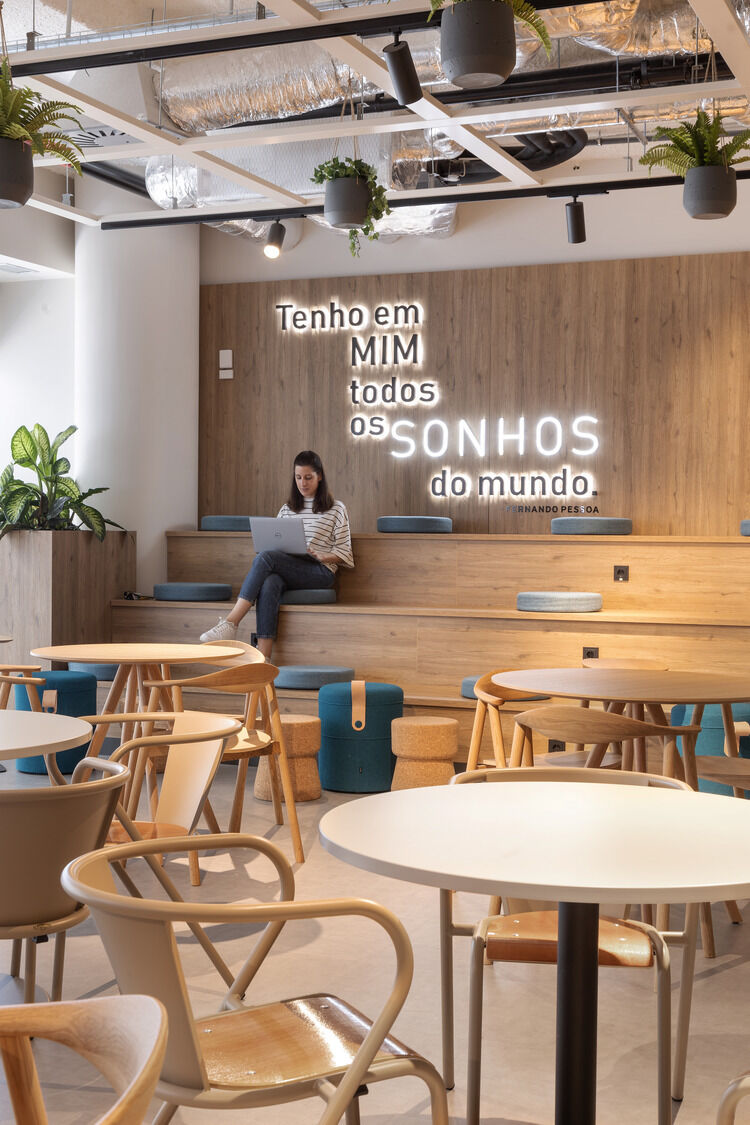
A similar philosophy applies in corporate settings. At Google Ananta in Bengaluru and EY’s Lisbon headquarters, flexible neighbourhoods, shared amenities, collaboration spaces and quieter settings allow people to select the right environment not just for the task, but for the learning moment within it.
Designing for resilience

The “war for talent” is often framed in terms of perks but the workplace’s most sustainable differentiator is not a barista bar or a games room but the offer of an environment that helps people grow professionally, socially and creatively.

The organisations that thrive will be those that treat learning as a platform supported by space, reinforced by culture and enabled by design.

As architects, we have a clear role to play in creating workplaces where learning distributed across an ecosystem and space is part of an organisation’s skills strategy.

Listing details