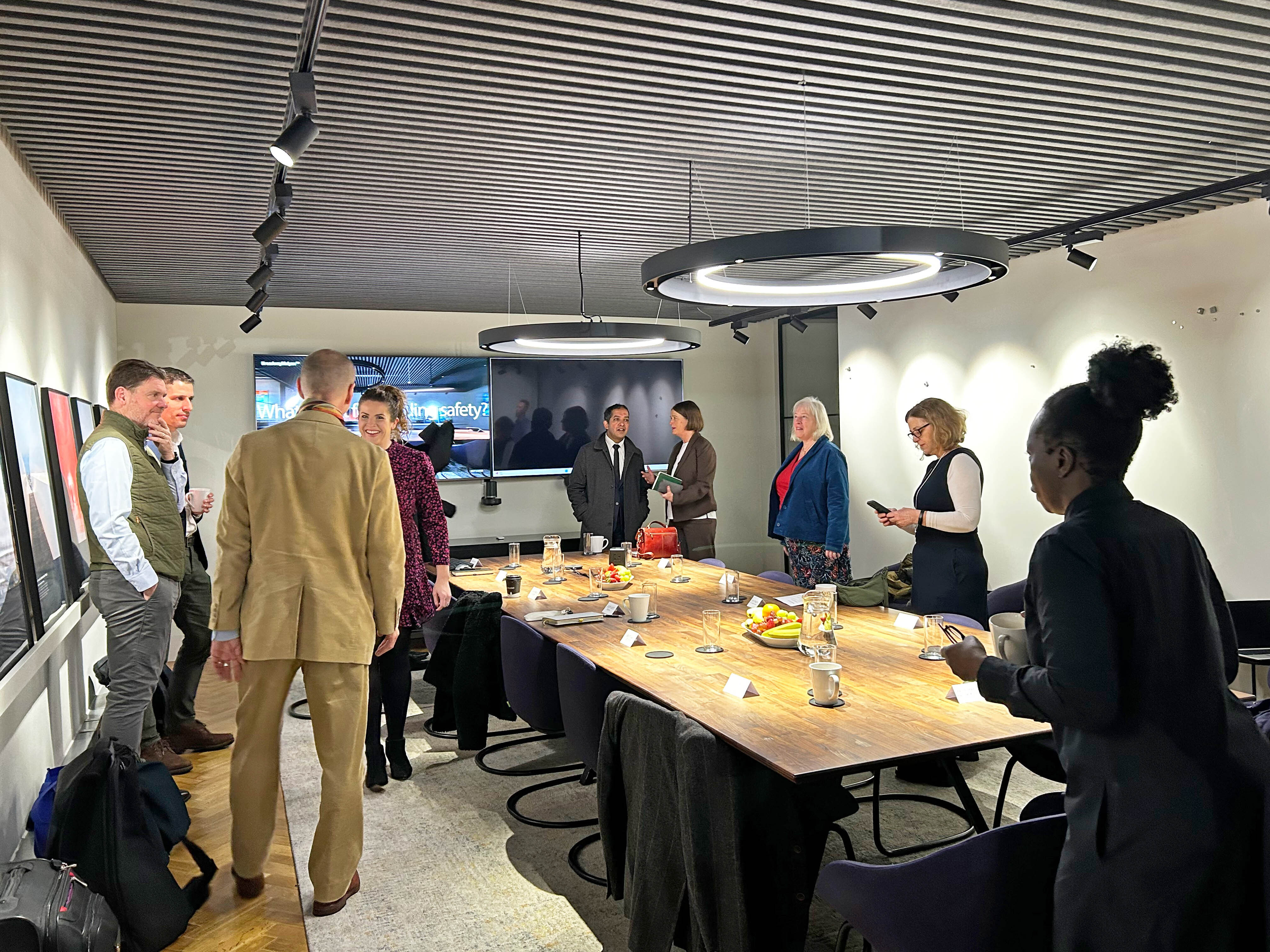
Chaired by Sarah Rawlings, the discussion was structured around three questions and sought to identify solutions that addressed shared challenges. The questions posed were;
What are the key challenges and business impacts of the current Gateway approval system?
As the BSR seeks to rebuild confidence in Gateway 2, what should its top priorities be to help the industry progress?
Given similar concerns around Gateway 3, how is the industry preparing, and what must the BSR address to ensure homes are delivered more speedily?
This paper summarises the responses and recommendations of the discussion. Broadway Malyan are grateful to all participants for lending their time and sharing their experience for the wider benefit of future design, planning and construction.
Attendees
- Robyn Prince, Head of Strategic Growth, Vistry (London Division)
- Harry Drimussis, Technical Director, Places for People
- Graeme Whyte, Pre-Construction Director, Regal
- James McNay, Divisional Director, Fire Safety, Stantec
- Sally Rawlings, Interim Principal Development Manager, LB Ealing
- Bryn Marler - head of pre-construction design, Ballymore Group
- Matthew Gibbs, Director, Planning, Savills
- Jehan Weerasinghe, Corporate Director for Neighbourhoods and Regeneration, LB Brent
- Alex Molliex, Mobile Broadband Network Ltd (MBNL)
Implementation of the Building Safety Act
The Building Safety Act (BSA) introduces a fundamental shift in accountability: anyone who owns or operates a building is now legally responsible for understanding and mitigating building safety risks. This is a statutory duty with criminal implications and must be considered from the earliest moments of project conception. For High-Risk Buildings (HRBs) in particular, creative ambition and technical compliance are now inseparable. The aspirational stages of design must also address the practical realities of regulatory scrutiny, creating a new level of discipline in early-stage development.
The Act introduces three key gateways - planning, pre-construction, and post-construction - each requiring increasingly robust evidence to demonstrate safety and compliance. While the industry recognises progress, the prevailing sentiment is cautious optimism rather than celebration. The system is improving but remains slow, inconsistent and constrained by limited resources. Duplication of issues between Gateways 2 and 3 remains a central concern and there is widespread acknowledgement that skills shortages in building control, fire engineering and regulatory oversight are now existential challenges. The need for clearer interpretation of building codes, better-structured pre-application engagement, and improved communication with residents and political stakeholders is becoming increasingly urgent.
Current Experience of Gateway 2
Social housing and local authority perspective
Gateway 2 is beginning to reveal its full impact, particularly for local authorities and social housing providers. Transitional schemes - many of them low-rise - have masked the effect to date, but the system will “bite” much harder in the coming year as more projects enter the process.
Local authority housing revenue accounts are under extreme pressure, driven by escalating temporary accommodation costs and the growing number of completed buildings that cannot yet be signed off for occupation. Some homes are already sitting empty, with significant financial repercussions.
Despite these pressures, social housing is currently sustaining much of the industry’s output, as grant-funded low-rise homes remain more feasible than speculative higher-risk schemes. Upfront grant funding is increasingly being used to cross-subsidise broader development programmes.
However, subjecting all schemes - regardless of tenure - to the same level of rigour creates significant capacity and cost challenges. Compounding this is a limited political understanding of the genuine impact that Gateway processes have on viability, delivery timelines and service budgets. Planning timescales continue to lengthen, with some decisions now taking 12–18 months, creating deep uncertainty and leaving construction resources idle for extended periods.
Fire safety, codes and technical ambiguity
Technical ambiguity remains one of the greatest obstacles in navigating Gateway 2. Untested details, insufficient evidence bases and inconsistencies in judgment lead to excessive caution and prolonged delays. While every building will naturally contain elements without extensive precedent, the threshold for acceptance is currently unclear, and the result is often a default refusal or return for further evidence.
Interpretation of codes remains inconsistent - notably around BS 9991, where views differ on how prescriptive or flexible the guidance should be. Regulation 7, particularly the definition and limits of “zero combustibles,” is also a recurring point of contention. There is persistent anxiety that issues agreed at Gateway 2 could be revisited or contradicted at Gateway 3 if a different case officer or fire engineer reviews the application. Compared with other jurisdictions where strict adherence to codes provides certainty, the UK’s more interpretive approach is contributing to stagnation.
Role of Architects and project staging
Design teams report that the role of the architect has fundamentally changed. Discussions previously reserved for later technical stages - including fire strategy, construction methodology and compliance testing - now begin much earlier in the process, even forming part of feasibility conversations. There is increasing recognition that traditional RIBA workstage boundaries no longer align with the demands of the Gateway system. Creativity must now operate within a narrower, more binary framework to avoid exploring design avenues that will ultimately prove non-compliant. This shift is redefining workflows, responsibilities and expectations from the outset of a project, and re-aligning workstage assumptions to these.
Skills, capacity and resourcing
The industry is contending with acute resourcing challenges at precisely the moment when expertise is most needed. Building control services have contracted significantly, with some estimates suggesting around a 40% reduction in capacity. In fire engineering, the number of chartered professionals is far below what the system requires, and the closure of several higher education programmes, including leading fire engineering degrees and apprenticeships in Glasgow and Birmingham, has exacerbated the shortage. Recruiting international specialists is increasingly expensive due to rising visa and employment costs.
Many practitioners are calling for standard templates, such as pre-approved material solutions, to reduce unnecessary dialogue and provide consistency. There is also growing interest in the role AI could play in improving efficiency, although digital capability within many organisations - particularly around data integration and digital twins - remains limited.
Developer/investor perspective and viability
The BSA has fundamentally altered the development model. Previously, obtaining planning consent was the key milestone, providing flexibility in how and when to proceed. Under the new regime, the entire supply chain must be engaged early to meet Gateway requirements, effectively eliminating the traditional Design & Build approach for many projects. The result is longer programmes, higher costs and significantly reduced flexibility.
Gateway 2 timings remain unpredictable. While some optimism exists around gradually reducing determination periods, developers are still experiencing lengthy delays, with major portfolios often comprising numerous applications at various stages without clear visibility of when they will progress. Securing forward funding has become exceptionally difficult, as investors are increasingly reluctant to commit before Gateway 2 approval. This has led many developers to pivot toward single-family homes, which carry fewer regulatory and financial risks, and others are considering their next moves.
The spectre of completed buildings stuck in regulatory limbo presents a serious threat to viability. Instances where projects cannot be occupied due to inspection or approval challenges highlight the financial exposure developers face. There is widespread concern that if Gateway 3 replicates the difficulties of Gateway 2, the cumulative effect could force some developers - particularly SMEs - out of the market altogether.
Approvals, conditions and on-site reality
There is a strong industry appetite for greater use of conditional approvals within the Gateway process. Allowing non-critical matters to be addressed later, while still permitting early construction activities such as piling and frame erection, could significantly improve programme certainty without compromising safety. Many argue that focusing on the core life-safety elements of Part B should enable this flexibility.
On-site, the inspection regime continues to evolve. Inspectors are not always regularly present, resulting in a system heavily reliant on photographic evidence, recorded inspections and robust O&M documentation. This demands a digital-first approach from day one, ensuring that all information required for future scrutiny is captured systematically.
A consistent theme is the need for continuity. Projects benefit greatly when the same inspector or case team follows a scheme through to Gateway 3. Any change in personnel increases the risk of reinterpretation or re-opening of settled issues, contributing to delays and uncertainty. There is also a clear recognition that Gateway 2 and 3 issues must be tightly delineated to avoid duplication.
Social outcomes, residents and future costs
Building safety is ultimately about people, and the Gateway process must reflect this. Key considerations include appropriate fire strategies, routes of escape and the provision of dignified evacuation options such as evacuation lifts. Many organisations are developing long-term asset management plans for lifts and other fire-critical systems, although these can take considerable time to establish.
Clear communication of the major reasons for delay remains an issue across the political spectrum, with the ramifications of the BSA still misunderstood by policymakers promoting housing growth. There is also recognition that the broader public must better understand the reasons behind delays and the importance of compliance to maintain confidence in the system.
Financial impact on Boroughs and residents
The financial implications of the BSA extend beyond development viability to affect local authority budgets, service charges and long-term affordability. Empty buildings awaiting approval generate no council tax revenue, and enhanced compliance costs are increasingly being passed through as higher service charges.
The transition from construction into management is also proving complex. Responsibilities around data transfer, building information and ongoing compliance obligations can take prolonged periods to resolve, adding further cost pressures on both landlords and residents.
Communication and public understanding
Effective communication is essential to support the long-term success of the Gateway system. There is a strong need to deal transparently with the issues, articulate the trade-offs between safety, cost and speed, and avoid creating the impression that development is being unnecessarily constrained. Building confidence in the new regulatory environment requires clarity, openness and a recognition that processes are still evolving.
There is widespread agreement that improved guidance, consistent interpretation, and a commitment to listening and learning from real project experience will be critical in the months and years ahead. Preparing thoroughly for Gateway 3 now, while also clarifying roles and responsibilities at each stage, will be crucial to ensuring smoother transitions and preventing the re-opening of previously settled issues.
Advocacy priorities
Looking ahead, several areas require collective advocacy and systemic improvement:
- Addressing the critical skills shortages in building control and fire engineering.
- Strengthening the financial resilience of local authorities and social landlords facing escalating costs.
- Expanding the use of conditional approvals where appropriate and safe.
- Ensuring continuity of inspector teams across gateways.
- Supporting education, apprenticeships and international recruitment to replenish technical expertise.
- Clarifying technical guidance and improving consistency in its interpretation.
- Enhancing digital capability across the sector to support evidence-based inspection and lifecycle compliance.